



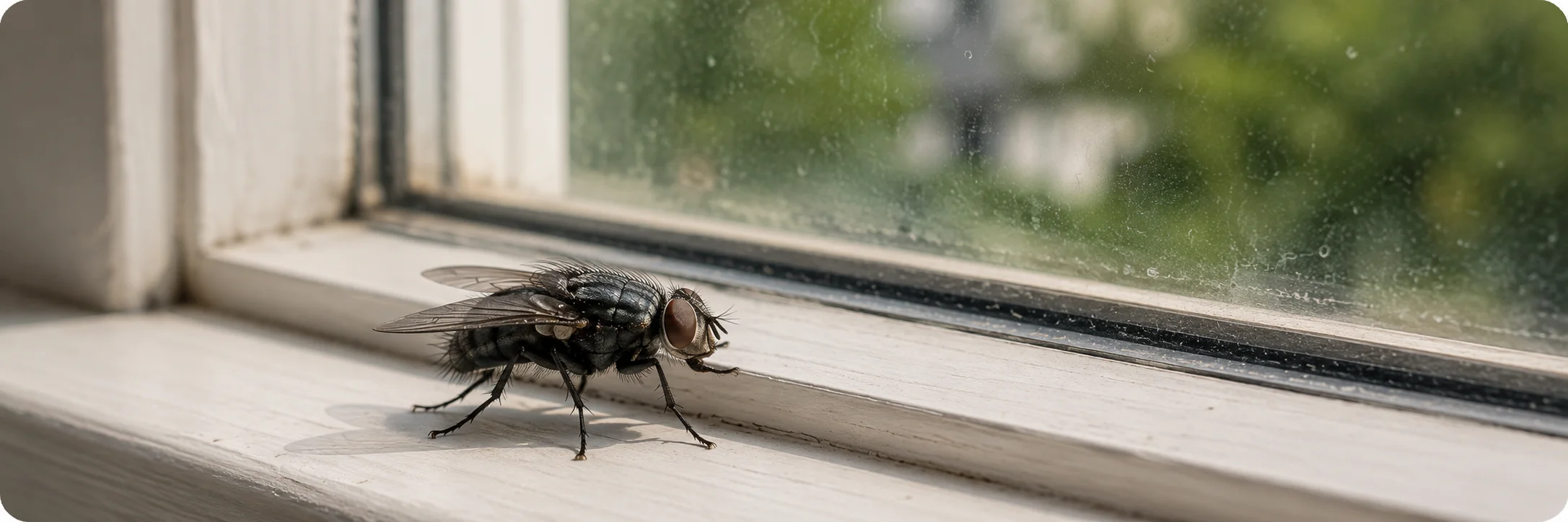
Flies
No more swatting. No more settling.
Explore Our Services
Flies are more than an annoyance — they’re a serious sanitation and health concern. House flies and blow flies breed in garbage and organic waste and can contaminate food and food-prep surfaces with over 100 known pathogens, including E. coli and Salmonella. Drain flies, fruit flies, and fungus gnats signal decaying organic matter or plumbing issues within your home. Identifying the species is essential to finding and eliminating the source.
Select Exterminating takes a source-elimination approach to fly control. Our technicians don’t just treat adult flies — they identify and eliminate the breeding sites that fuel the infestation. Whether it’s a drain issue, an exterior waste problem, or a structural entry point, we address the root cause and deploy targeted treatments that deliver lasting results.
Understanding fly infestations
Flies breed fast and spread quickly — and where you see them is often not where they’re coming from. Understanding the signs of a fly infestation can help pinpoint the source before the problem escalates:
Clusters of flies around windows, drains, or trash areas
Large numbers of flies congregating near specific points — light sources, drain openings, garbage areas, or doorways — indicate an active breeding site nearby. Cluster flies in upper floors and attics are a separate issue, overwintering inside wall voids in large numbers as temperatures drop.
Small flies hovering over drains, fruit, or houseplants
Description: Small flies near drains suggest organic buildup inside the drain line that's supporting a breeding population. Fruit flies hovering over counters, trash cans, or produce are reproducing in fermenting organic material. Fungus gnats near houseplants indicate overly moist soil with decaying root matter.
Our fly treatment process
Because different fly species require completely different treatment strategies, proper identification is the foundation of everything we do. Here’s how our technicians tackle fly infestations from source to solution:

Detailed Inspection
Our technicians identify the fly species, locate all breeding sources — both interior and exterior — and assess any structural or sanitation conditions contributing to the infestation. Proper identification determines the entire treatment strategy.

Treatment Plan
Treatment is species-specific. We use drain cleaning treatments and bio-enzymatic products for drain flies, targeted baiting and trapping for house flies, exclusion and interior treatments for cluster flies, and source-elimination guidance combined with product applications for fruit flies and fungus gnats.

Follow-Up
We schedule follow-up visits to confirm breeding source elimination, reassess any remaining activity, and adjust treatments as needed. Without source elimination, fly populations will rebound regardless of what surface treatments are applied.

4.9/5
Over 4,700 Reviews
Why choose our fly treatment
Our fly treatment utilizes the latest advances in technology and eco-friendly methods. With years of experience and thousands of successful treatments, we deliver complete elimination every time.
Source-elimination approach that targets breeding sites, not just adult flies
Species-specific identification for precise, effective treatment
Drain treatments, exclusion, and exterior management for full-property control
Frequently asked questions
Why do I keep getting flies in my home even when I keep it clean?
Flies can breed in small amounts of organic material — a slow drain, a forgotten piece of produce, or moisture under a potted plant. They also enter from outside through gaps around doors, windows, and utility lines. Even a well-kept home can have conditions that support fly activity if breeding sources are present.
What's the difference between fruit flies and drain flies?
Fruit flies are small, tan-colored flies with red eyes found near produce, alcohol, and sugary spills. Drain flies are slightly larger with fuzzy, moth-like wings and are found near sink and floor drains where organic slime accumulates. Both require source elimination, but the treatment approaches differ significantly.
Are cluster flies dangerous?
Cluster flies are not associated with disease transmission and don’t breed indoors — they overwinter inside wall voids and attic spaces to survive the cold. However, large cluster fly invasions can involve thousands of flies and become a serious nuisance. They require exclusion treatment in late summer before they enter the structure.
Can flies make my family sick?
Yes. House flies and blow flies are capable of transmitting over 100 disease-causing pathogens. They feed on garbage, feces, and decaying matter and then land on food and food-prep surfaces, transferring bacteria through their feet and mouths. Fly control in kitchens and food storage areas is a genuine public health concern.
How long does it take to get rid of a fly infestation?
Once breeding sources are eliminated, fly populations typically decline within 1 to 2 weeks as the existing adults die off without reproducing. However, as long as a breeding source remains — even a partially clogged drain — the infestation will persist. Source elimination is the only path to lasting control.