



Silverfish

Ancient pest. Modern solution.

Silverfish are primitive insects that have existed for over 400 million years — and they’ve evolved into remarkably efficient household survivors. These fast-moving, moisture-loving pests feed on the starches and sugars found in book bindings, wallpaper paste, clothing, stored paper, and pantry goods. While they don’t bite or transmit disease, they can cause significant and irreversible damage to irreplaceable books, documents, clothing, and wallpaper over time.

Silverfish thrive in high-humidity environments, which is why they’re most commonly found in bathrooms, basements, attics, and kitchens. A silverfish infestation often signals a moisture problem that, if left unaddressed, will continue to attract and sustain pest populations. Select Exterminating eliminates the infestation and helps you address the conditions driving it.

Understanding silverfish infestations

Silverfish are fast, elusive, and most active at night — which means an infestation can grow undetected for months before homeowners realize they have a problem. Here’s what to watch for:

Silverfish or their shed skins in damp areas

Finding silverfish — teardrop-shaped, silver-gray insects about 3/4 inch long — in bathtubs, sinks, or on bathroom floors is the most direct sign of an infestation. They move in a rapid, fish-like wriggling motion. Shed exoskeletons found behind books, in boxes, or along baseboard cracks also confirm their presence.

Irregular feeding damage on paper, fabric, and starchy materials

Silverfish feed by scraping the surface of materials rather than chewing through them, leaving behind irregular yellowish stains, etch marks, or holes in paper, book pages, wallpaper, and natural-fiber fabrics. Finding this type of damage in storage areas, closets, or along shelving is a strong indicator of silverfish activity.

Our silverfish treatment process

Silverfish control requires addressing both the active population and the moisture conditions sustaining it. Our technicians take a whole-home approach that eliminates the infestation at its source:

Detailed Inspection

Our technicians inspect all high-moisture areas throughout your home, identify harborage sites, and assess the moisture and humidity conditions that are supporting the infestation. Access points between living spaces and attic or crawl space areas are examined as well.

Treatment Plan

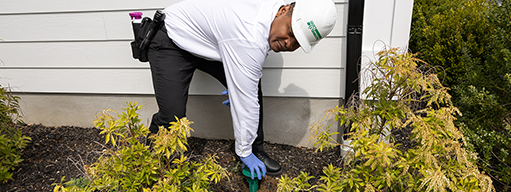
We apply targeted residual treatments in harborage areas and along silverfish travel routes, combined with dust in wall voids and attic spaces where silverfish populations often originate. Moisture reduction recommendations are provided as a critical component of long-term control.

Follow-Up

We schedule a follow-up to confirm treatment effectiveness and re-assess moisture conditions. If humidity levels remain elevated, silverfish will continue to be attracted to the property regardless of treatment — so we work with you to address the root cause.
4.9/5

Over 4,700 Reviews

Why choose our silverfish treatment

Our silverfish treatment utilizes the latest advances in technology and eco-friendly methods. With years of experience and thousands of successful treatments, we deliver complete elimination every time.

Residual treatments and void dusting targeting both living spaces and harborage areas

Moisture assessment and reduction guidance integral to every treatment plan

Attic and crawl space inspection to identify populations at their source

Frequently asked questions

Silverfish are not dangerous to humans — they don’t bite, sting, or transmit disease. Their harm is entirely to property. They can cause significant damage to books, documents, photographs, clothing, and wallpaper, particularly in storage areas where infestations go undetected for long periods.

Attics are a surprisingly common silverfish habitat because they often have high humidity, cellulose-rich insulation materials, and abundant paper and cardboard from stored boxes. Silverfish in attics can be particularly destructive to stored belongings and can filter down into living spaces through gaps in ceilings and walls.

Silverfish require high humidity (70–90% relative humidity is ideal) and a food source high in starches or sugars. Leaky pipes, poor bathroom ventilation, damp basements, and moisture in crawl spaces are the primary attractants. Reducing humidity through dehumidification and improved ventilation is an important part of any silverfish management program.

DIY products can kill individual silverfish but rarely reach populations hidden in wall voids, attic spaces, and deep within structural crevices. Without addressing the underlying moisture conditions, new silverfish will continue to be attracted to your home. Professional treatment combined with moisture control is significantly more effective for lasting results.

Residual treatments begin working immediately upon contact. Most homeowners notice a significant reduction in visible silverfish within 1 to 2 weeks. Full control of a well-established population may take 4 to 6 weeks, particularly in homes with persistent humidity issues that need to be corrected alongside treatment.

We’re here to help.

Contact Form